


Over the last ten years, my work has slowly evolved from pure AI Product Management into a role that increasingly lives at the intersection of AI Strategy and AI Product Strategy. The transition did not feel like a deliberate move toward strategy. It felt more like following the problems wherever they led me.
In the beginning, my world was clear. Understand users. Shape solutions. Deliver value. Improve adoption. Measure outcomes. Like many product managers, I believed the hardest challenges lived inside the product itself. If we understood the problem deeply enough and built well enough, success would follow.
But over time, something kept happening. Good ideas struggled. Strong teams delivered promising AI solutions that never scaled. Technically sound systems disappeared after pilots. And the reasons were rarely technical.
I slowly realized that many AI problems were not product problems at all.
They were strategic ones.
Most of my experience comes from building AI inside large enterprises. Organizations with thousands of employees, deeply interconnected processes, legacy systems, governance obligations, and competing priorities. AI behaves very differently in this environment compared to startups. In startups, the central challenge is usually product–market fit. In enterprises, the challenge is often something else entirely. The question is less whether AI works, and more whether the organization is capable of letting AI work. I increasingly began to think of this as product–organization fit.
At that time, strategy still felt abstract to me. I associated it with executive discussions and long planning cycles, slightly detached from the reality of building products. Product work felt tangible. Strategy felt distant.
It took years to understand that strategy is not removed from execution. Strategy is an attempt to understand reality deeply enough so execution has a chance to work.
Today, I see strategy as a set of beliefs.
Strategy is a collection of convictions about how progress actually happens.
Every organization carries an idea of a future it wants to reach. Strategy lives between today’s constraints and that future ambition. It tries to answer a deceptively simple question:
What must be true for us to get there?
Only later did I realize that this understanding closely aligns with how thinkers like Richard Rumelt describe strategy, not as planning activity but as diagnosing reality and choosing coherent action based on that diagnosis.
Once I began thinking about strategy this way, something unexpected became obvious.
The best product managers I had worked with were already doing strategy work long before anyone called it strategy.
Great product managers constantly form beliefs. They observe users and conclude that adoption matters more than feature completeness. They recognize that workflow integration beats technological sophistication. They learn that solving one painful problem creates more value than delivering many impressive capabilities. They understand that timing inside an organization often matters more than innovation itself.
These are not execution decisions. They are strategic judgments.
Modern product thinking, shaped by voices such as Marty Cagan and Teresa Torres, increasingly frames discovery itself as decision-making under uncertainty. Product managers constantly test beliefs against reality. Products punish wrong assumptions quickly. Adoption declines. Value disappears. Reality corrects you.
Product management, at its best, is strategy operating under fast feedback loops.
The transition into AI Strategy did not replace this mindset. It expanded it.
Instead of only understanding users, I began trying to understand organizations. Instead of asking why a product succeeds, I asked why organizations repeatedly struggle to let good products succeed.
Strategy increasingly felt less like planning and more like sense-making. Organizational theorists such as Karl Weick describe organizations as systems constantly interpreting reality rather than executing perfectly designed plans. That description resonated deeply with what I observed in enterprise AI environments.
This distinction becomes especially visible in AI.
In startup environments, product strategy and company strategy often evolve together because organizations are small and adaptable. In enterprises, these layers separate. Organizational complexity introduces friction long before product quality becomes the deciding factor. This is why AI Strategy becomes necessary even before individual AI products can succeed.
An AI Product Strategy emerges from discovery. We study how work is actually done, where friction exists, and what outcomes matter. We form beliefs about how a specific AI product creates value. These beliefs translate into product principles, experiments, epics, and roadmaps. The goal is clear: build something people adopt and trust.
AI Strategy asks a different question entirely:
How must the organization evolve so AI products can succeed repeatedly?
Here, discovery shifts from users to systems. We observe data accessibility, governance structures, delivery models, incentives, organizational maturity, and cultural readiness. We form beliefs about how AI value can realistically emerge within that environment.
One strategic belief that fundamentally changed my perspective was simple:
AI development must be treated as product development, not as one-time projects.
While this realization may sound simple and almost obvious to experienced product managers, its implications are far-reaching. Once we understand that many AI challenges are strategic rather than technical, the perspective changes. The question is no longer how to build better models, but how organizations must evolve to let those models create value. Decisions around funding, governance, ownership, and delivery suddenly look different. AI stops being a project to deliver and becomes a capability to nurture. Success moves away from completion toward sustained adoption, and learning becomes continuous rather than episodic. AI product teams therefore cannot disappear after go-live. They must remain with the product, continuously learning, improving, and evolving it instead of moving immediately to the next promising AI use case.
Another belief follows almost inevitably. If AI products evolve continuously, organizations must continuously discover AI opportunities. Innovation cannot depend on isolated initiatives. It requires structured observation and prioritization. From this belief emerges capabilities such as scalable AI Opportunity Management. Not as temporary programs, but as permanent organizational muscles connecting strategy with product creation.
This is where strategy becomes beautiful to me.
Strategy is not about inventing actions. It is about understanding consequences. When beliefs are coherent, organizations begin aligning almost naturally. Structures reinforce direction. Investments gain meaning. Decisions stop competing and start supporting each other.
At the same time, strategy work is difficult because organizations are complex systems. Improving one area often creates pressure elsewhere. Automating a workflow may accelerate one team while overwhelming another. A technically strong AI product can fail because governance was not prepared. A well-articulated AI Strategy can exist without impact if no meaningful products ever emerge.
Strategy requires living with ambiguity longer than product work usually demands. Feedback loops slow down. Impact becomes indirect. Instead of shipping features, you shape conditions. Instead of solving a single problem, you influence how many problems can be solved in the future.
Stepping into an AI Product Strategy Lead role therefore did not mean moving away from products. Quite the opposite.
The role lives exactly between strategy and product execution.
On one side, it contributes to AI Strategy by helping define organizational beliefs, capabilities, and directions that allow AI to scale responsibly and effectively. On the other side, it stays deliberately close to AI products themselves. Guiding product teams. Challenging assumptions. Supporting AI Product Managers in strengthening their product strategies. Ensuring discovery remains grounded in reality. Translating organizational ambition into adoptable solutions.
The role constantly translates in both directions.
Strategy informs products.
Product reality informs strategy.
AI Strategy without proximity to products becomes theoretical.
AI Product Strategy without organizational alignment becomes fragile.
My work increasingly focuses on connecting both worlds.
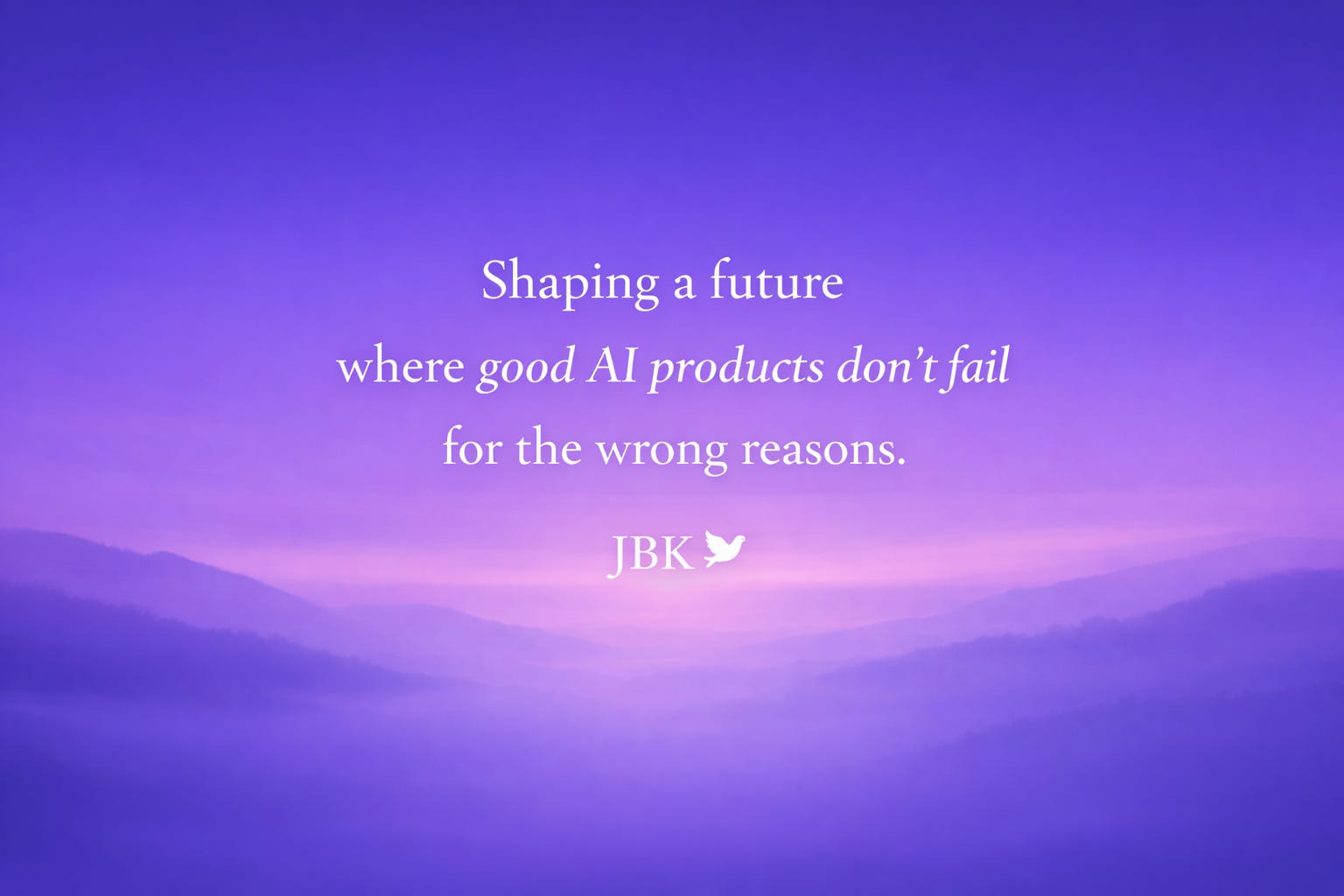
This connects deeply to something personal for me. My LinkedIn profile background carries the sentence:
Shaping a future where good AI products don’t fail for the wrong reasons.
That sentence expresses how I understand strategy today.
Most AI products do not fail because models are weak. They fail because organizations were not ready. Because incentives discouraged adoption. Because discovery was skipped. Because governance arrived too late. Because strategy and product evolved separately instead of together.
Looking back, I do not see a transition away from product management. I see an expansion of product thinking itself. The same curiosity that once helped understand users now helps understand systems. The same discovery mindset now applies to organizations.
Seeing AI Strategy through the eyes of an AI Product Manager ultimately means refusing to separate strategy from products. It means staying close enough to real work to remain grounded, while thinking broadly enough to shape the environment in which that work succeeds. Strategy then stops being an abstract exercise and becomes a continuous dialogue between organizational direction and product reality. Every strategic belief must eventually prove itself in adoption, usage, and sustained value creation. And every product insight becomes an input to strategy itself, shaping how the organization learns and evolves.
In the end, AI Strategy is not about defining a future from a distance. It is about creating the conditions in which good AI products are given a real chance to succeed.
JBK 🕊️